How North Texas Clay Soil Impacts Your Fence Posts (And How to Prevent Leaning)
How North Texas Clay Soil Impacts Your Fence Posts (And How to Prevent Leaning)
How North Texas Clay Soil Impacts Your Fence Posts (And How to Prevent Leaning)
If you've lived in Collin or Denton County for more than a single summer, you already know about our infamous local soil. The heavy, dark clay beneath our feet is notorious for cracking foundations, splitting driveways, and—most commonly—causing backyard fences to lean at a precarious 45-degree angle.
Understanding how this soil behaves is the secret to building a fence that stands perfectly straight for years to come.
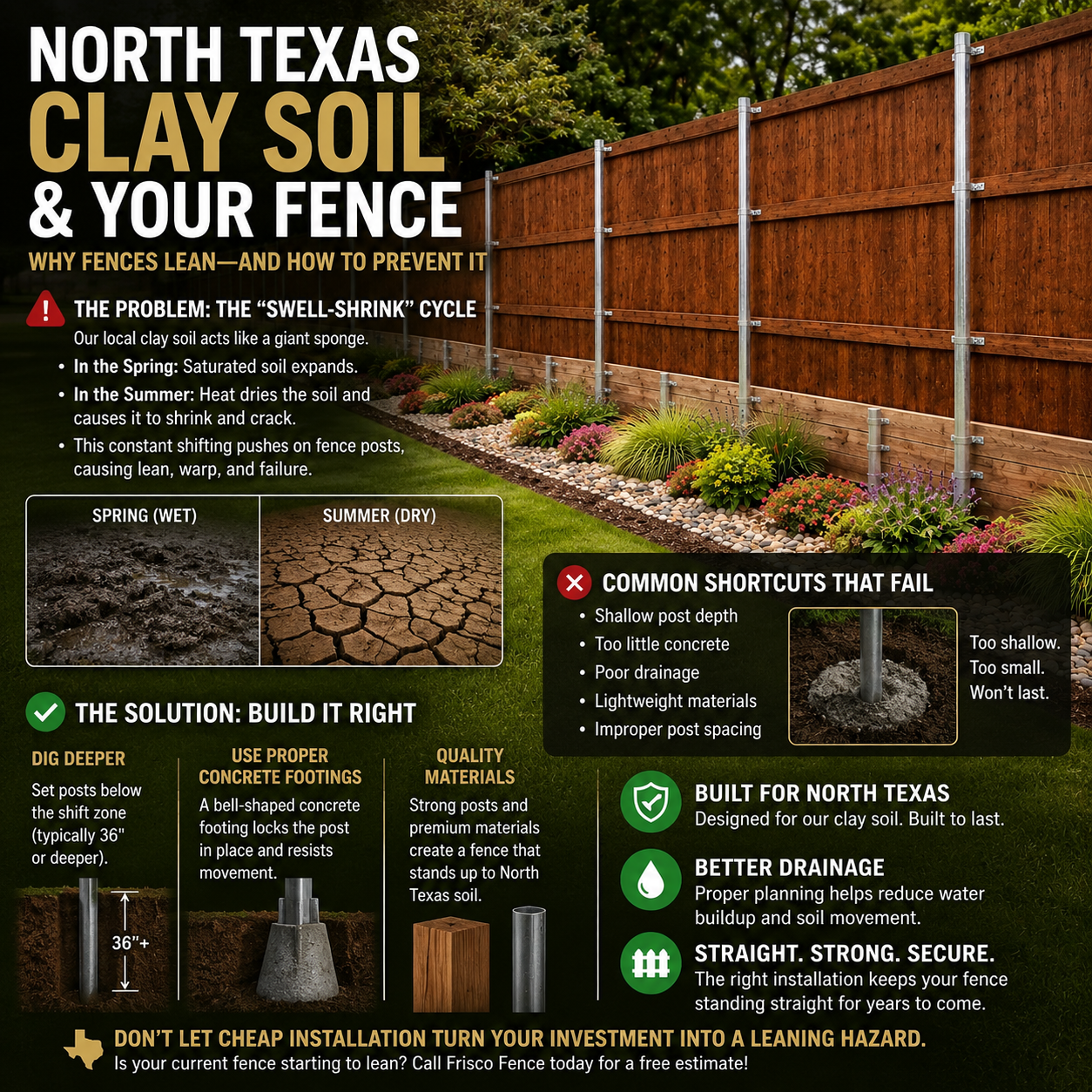
The Problem: The "Swell-Shrink" Cycle
Our local clay soil acts like a giant sponge.
- In the Spring:Heavy rains saturate the clay, causing the soil to expand drastically (swelling).
- In the Summer:Consecutive days of 100°F+ heat bake the earth, causing the moisture to evaporate. The soil contracts, leaving deep, wide cracks in the ground.
This constant shifting exerts massive lateral pressure on everything buried in it. If a fence contractor cuts corners on the post installation, this shifting earth will slowly pop the concrete footings out of alignment, causing your fence lines to warp and lean.
The Solution: Deep Posts and Proper Concrete Footings
To beat the Texas clay, a fence must be engineered from the ground up. Here is how we ensure structural integrity:
- Digging Past the Shift Zone:Fence posts cannot simply be placed two feet into the ground. They must be set deeply into the earth to reach past the top layers of soil that experience the most violent shifting.
- Properly Spec’d Concrete Footings:Shoving a post into a hole and pouring a tiny bag of dry concrete around it won't cut it. A robust, bell-shaped concrete base anchors the post firmly, resisting the upward and outward pressures of expanding clay.
- High-Quality Materials:Pairing proper depth with heavy-duty metal posts or thick, premium wood posts ensures the structural skeleton of your fence can handle the physical weight of premium cedar pickets.
Don't let cheap installation methods turn your new investment into a leaning hazard after the first major weather shift.
Is your current fence starting to lean?Give Frisco Fence a call today. Let’s get your property secured with a structurally sound fence built specifically to handle North Texas soil.